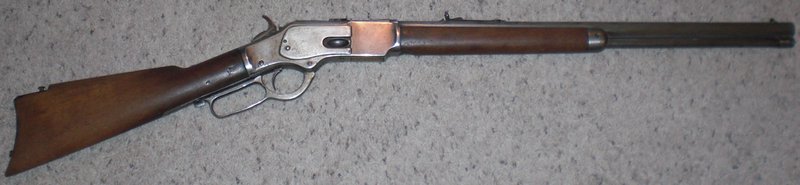
Winchester Model 1873
- Manufacturer
- Winchester Repeating Arms
- Country
- United States
- Cartridge
- .44-40 WCF, .38-40 WCF, .32-20 WCF
- Action
- Lever-action
- Barrel Length
- 24 in (rifle), 20 in (carbine)
- Overall Length
- 43.3 in (rifle)
- Weight
- 7.5 lb
- Capacity
- 15 rounds (rifle), 12 rounds (carbine)
- Production Years
- 1873–1919
- Total Produced
- 720,610
The Winchester Model 1873 earned the legendary title “The Gun That Won the West,” and few firearms in American history carry as much cultural weight. Developed as an improvement over the Model 1866 “Yellow Boy,” the 1873 introduced an iron receiver in place of the earlier brass frame, offering greater strength and durability. Its toggle-link lever action, derived from the earlier Henry and Volcanic designs, provided a fast and reliable repeating mechanism that gave its owner a decisive advantage over anyone armed with a single-shot rifle on the frontier.
Chambered originally in .44-40 Winchester Center Fire, the Model 1873 achieved something remarkable for its era: true ammunition commonality between rifle and revolver. The Colt Single Action Army was also offered in .44-40, meaning a frontiersman, cowboy, or lawman could carry one cartridge that fed both his belt gun and his saddle rifle. This practical advantage was enormously appealing in remote territory where resupply was uncertain, and it cemented the 1873’s place as the preferred arm of the American West. Later chamberings included .38-40 and .32-20, further expanding its versatility.
Winchester produced over 720,000 Model 1873 rifles between 1873 and 1919, offering them in sporting rifle, carbine, and musket configurations. The carbine variant, with its shorter barrel and saddle ring, was especially popular with mounted riders and saw service with ranchers, miners, stagecoach guards, and both sides of the law throughout the frontier period. The rifle’s side-loading gate allowed the magazine to be topped off without opening the action, a meaningful tactical advantage that Winchester lever guns would retain for generations.
Originals in good condition are highly sought after by collectors, with documented provenance or association with notable historical figures adding tremendous value. The Model 1873 remains an icon of American firearms design, representing the moment when repeating rifle technology became truly practical and accessible to ordinary citizens across the expanding nation.